Preparing Virtue-Driven Scholars for Lifelong Learning
Virtue-Driven Information Literacy
Information literacy is a set of skills and habits that help students find, evaluate, and use information effectively and ethically in pursuit of truth. At the Wheaton College Library, we see it as both a practical skillset and a formational practice that prepares students to navigate information wisely in academic, professional, and personal contexts.
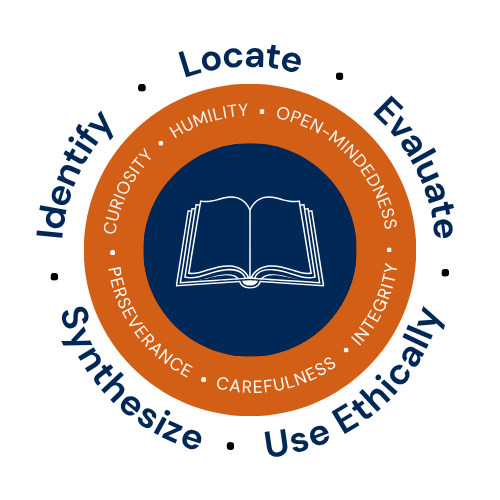
Information literacy is a moral and intellectual practice oriented toward truth, wisdom, and human flourishing. A virtue-driven researcher is motivated not by the need to complete a task or win an argument, but by a love of truth—and thus practices curiosity, humility, open-mindedness, perseverance, carefulness, and integrity.
When Christ-followers pursue truth with humility and care, their information practices become acts of formation—honoring God and loving their neighbors.
Download the Full Information Literacy Plan (PDF)
Goals and Vision
The Wheaton College information literacy program aims to form virtue-driven scholars—students who approach information with both skill and character. The program is designed to equip students with essential research competencies while also cultivating intellectual virtues that shape the way they seek, evaluate, and use information.
Research Competencies and Virtues
Our program equips students with research competencies and intellectual virtues that shape a vision of research as a moral and intellectual practice oriented toward truth, wisdom, and human flourishing.
Research Competencies
Students will develop transferable research competencies that allow them to navigate across different information landscapes, including the ability to:
- Identify and refine research questions
- Locate information across information landscapes
- Evaluate information for credibility, authority, and context
- Synthesize and communicate information
- Use information ethically, recognizing its value and impact
Intellectual Virtues
To complement the competencies, the program emphasizes intellectual virtues—excellences of character that relate to learning, enabling students to pursue truth. These virtues include:
- Curiosity
- Humility
- Open-mindedness
- Perseverance
- Carefulness
- Integrity
Program Structure
Information literacy instruction is scaffolded across four stages of the undergraduate curriculum. Click each box to learn more.
First-Year Seminar (FYS):
An online tutorial introducing foundational research skills and virtue-driven scholarship.
Access the CORE 101 tutorial here.
Access the CORE 102 tutorial here.
By the end of the FYS tutorial, students will be able to:
- Define Information Literacy: Describe information literacy and explain the skills, behaviors, and habits of mind that support effective inquiry.
- Recognize Information Types and Context: Explain how context shapes information, distinguish between popular and scholarly sources, and describe the role of peer review. (Curiosity, Carefulness)
- Locate Information Using Library Website Tools: Use website resources, such as Library Search and Research Guides, to find sources and connect with Subject Librarians for expert help. (Curiosity, Perseverance, Humility)
- Evaluate Information for Credibility and Authority: Use reliability indicators and the 5 Ws to evaluate sources carefully and thoughtfully. (Carefulness, Humility, Open-mindedness)
- Use Information Responsibly: Explain why citation matters, recognize successful paraphrasing, and identify key elements of a citation to avoid plagiarism. (Integrity, Carefulness)
Advanced Integrative Seminar (AIS):
An online tutorial emphasizing scholarly conversations, authority, and faith-and-learning integration.
By the end of AIS, students will be able to:
- Formulate and Refine Research Questions: Develop and adjust open-ended questions through exploration of scholarly conversations. (Curiosity, Perseverance)
- Engage with Scholarly Conversations: Identify key voices and perspectives in a scholarly conversation and remain open to revising ideas in light of new evidence. (Curiosity, Humility, Open-mindedness)
- Locate Information Using Advanced Strategies: Apply advanced search techniques using academic databases and resources, incorporating theological resources thoughtfully to support faith-and-learning integration. (Carefulness, Perseverance)
- Evaluate Authority and Context: Assess markers of authority and consider how context shapes credibility and relevance. (Humility, Carefulness, Open-mindedness)
- Synthesize and Communicate Thoughtfully: Organize and integrate information from multiple sources, connect faith and learning where appropriate, and present original ideas in ways that demonstrate virtue. (Carefulness, Integrity, Humility, Perseverance)
Course-in-the-Major (CIM):
Discipline-specific instruction taught through online modules or in-person instruction and focusing on research methods and tools relevant to each discipline.
By the end of CIM instruction, students will be able to:
- Understand the Disciplinary Information Landscape: Recognize the key types of publications, resources, genres, and scholarly conversations within their discipline. (Curiosity, Carefulness)
- Apply Discipline-Specific Research Strategies: Use specialized databases, tools, and methods essential for research in their discipline. (Carefulness, Perseverance)
- Evaluate, Synthesize, and Use Sources Ethically: Assess sources using disciplinary standards of credibility and relevance, integrate them effectively into their own work, and apply proper citation practices. (Carefulness, Integrity)
Capstone:
Online or in-person instruction that emphasizes the transfer of academic research competencies to workplace and lifelong learning contexts.
By the end of Capstone instruction, students will be able to:
- Explain the Concept of an Information Landscape: Define what an information landscape is, describe how context shapes information, and explain why this understanding is helpful for transferring research competencies to new settings. (Open-mindedness)
- Compare Academic and Workplace Information Environments: Describe how sources, systems, and information behaviors differ between academic and professional settings. (Open-mindedness)
- Connect Virtue-Driven Information Literacy to Lifelong Learning: Reflect on how their current research skills may need to shift or expand in professional contexts and explain how virtue-driven information literacy supports ongoing growth and adaptability. (Curiosity, Perseverance, Integrity)
The Library also provides research instruction in First-Year Writing and in other courses by request, supporting specific assignments and curricular goals across the curriculum. Contact your subject librarian to talk about instruction. Additionally, the Archives and Special Collections offers primary source instruction for classes across the disciplines. For more information, contact archives@wheaton.edu.